
Most marketing tells you what a service does. We'd rather show you. So we built a free tool, the Main Street Checkup, pointed it at our own website before anyone else's, fixed what it found, and wrote down every step. Then we walked a sample bakery through the full $79 Main Street Tune-Up so you can see exactly what you'd get.
Want to skip ahead? Type your website into the checkup and get your own pass-or-fix scorecard in a few seconds. No sign-up, and nothing is saved.
Run the free Main Street Checkup →Start from what a customer actually does
Elon Musk's advice for building anything is to reason from first principles: strip a problem down to what is actually true, instead of copying what everyone else does. Applied to a small shop's online presence, the true part is short. A customer:
- Searches on a phone: “bakery near me,” or your name.
- Glances at what comes up: are you open, is it close, do the photos and reviews look like a real, cared-for place?
- Taps call or directions. Or taps the next shop on the list.
That's it. Everything worth fixing first sits on that path, so that's all the checkup looks at: whether your site is secure and built for phones, whether your title and description make sense in a search result, whether a phone number is one tap away, whether your address and hours are on the page, whether Google can read your business details, and whether the page is light and fast enough to load in a parking lot. Each check comes with one plain-English reason and one fix.
The other half of the advice: the best part is no part. We left out the things that sound impressive but rarely decide whether a neighbor walks in, like keyword density scores, backlink counts and 40-page audit PDFs.
Case study #1: our own website
A tool that grades other people should grade its maker first. On November 2, 2026 we ran the checkup on thehivemindsolutions.com with our business name filled in.
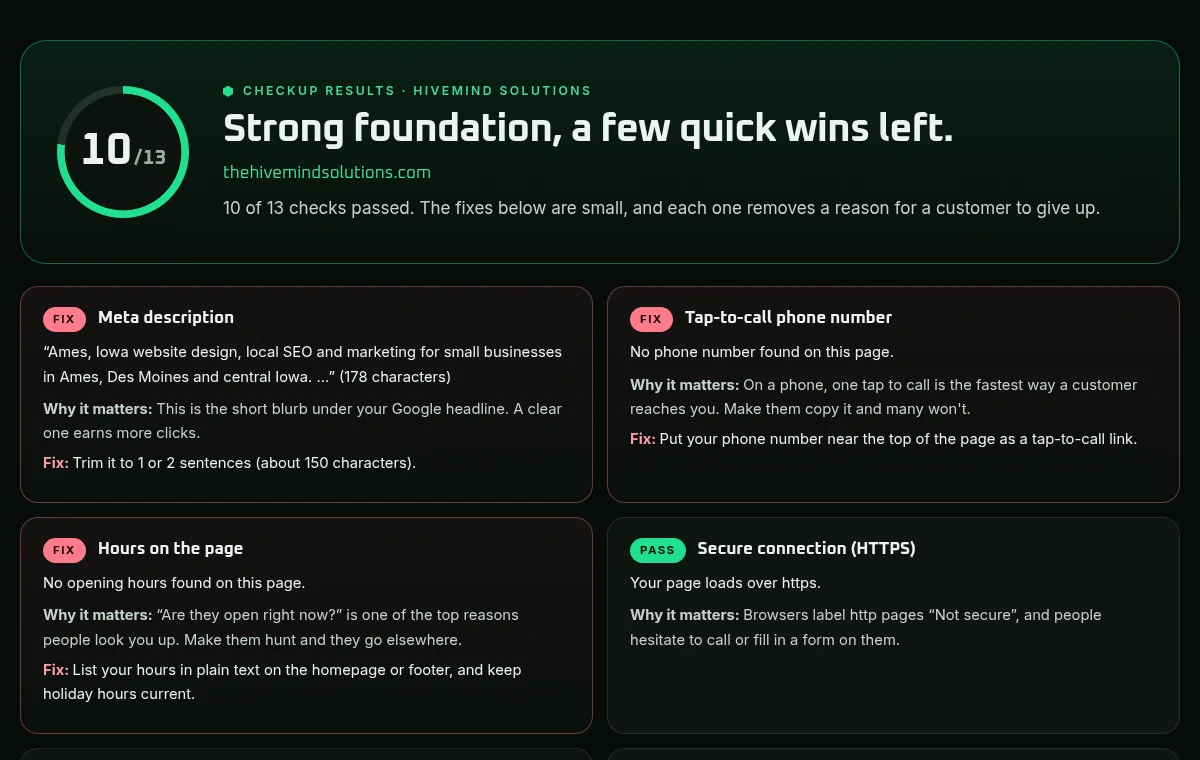
Ten of thirteen. Respectable, and still three reasons a customer could stall. Here is what it flagged and what we actually did about each one:
- Meta description was too long (178 characters). That's the short blurb under our name in Google, and anything past roughly 160 characters gets cut off mid-sentence. Fixed: we rewrote it at 154 characters, so the whole sentence shows.
- No hours on the page. We don't have a storefront, so we don't have opening hours, but a customer still deserves to know when they can meet us. Fixed: every page footer now says “Meetings by appointment only,” right under our address, which is the honest answer.
- No tap-to-call phone number. Not fixed, on purpose. Right now we answer by email and our contact form, and we'd rather show you a real gap than fake a pass. Publishing a phone number is a business decision, not a code change, and it's on our own fix-next list.
Then we ran it again.
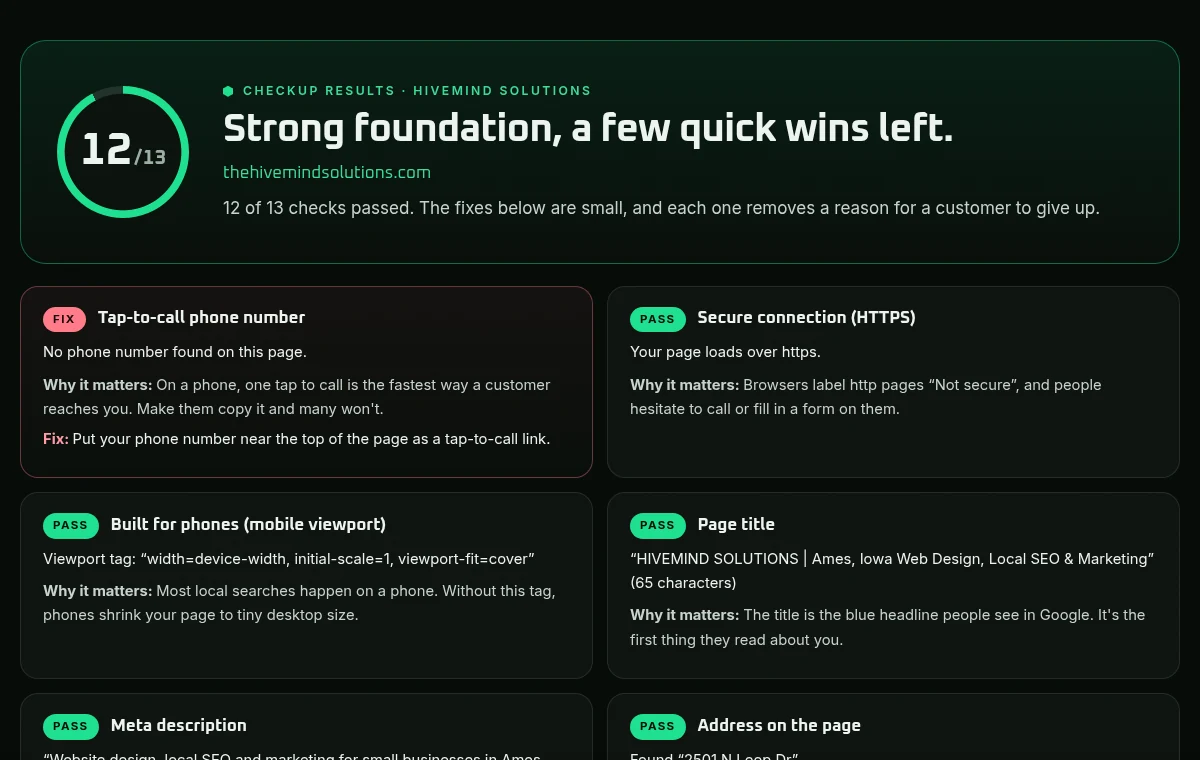
Two of the three fixes took a few minutes each. That's the point of the checkup: most of what stands between a searcher and a customer is small, specific and fixable, once someone points at it.
Example: a neighborhood bakery
Illustration · not a real business
Our own site is a web studio's site. The Tune-Up is built for the bakery, the barber and the repair shop, so here is what it looks like for one. “Example Bakery” is made up, and so are its details. But every problem below is one we see all the time on real Main Street listings.
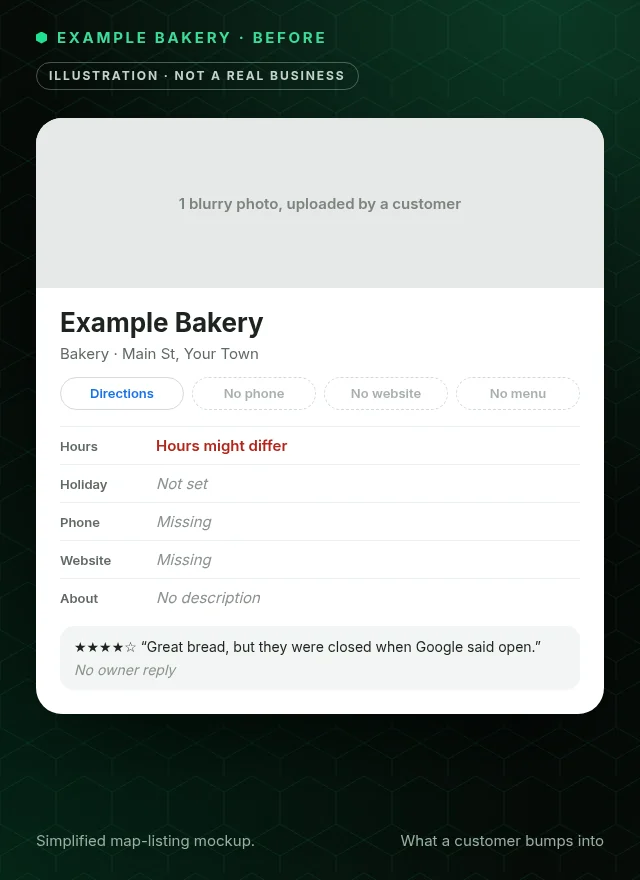
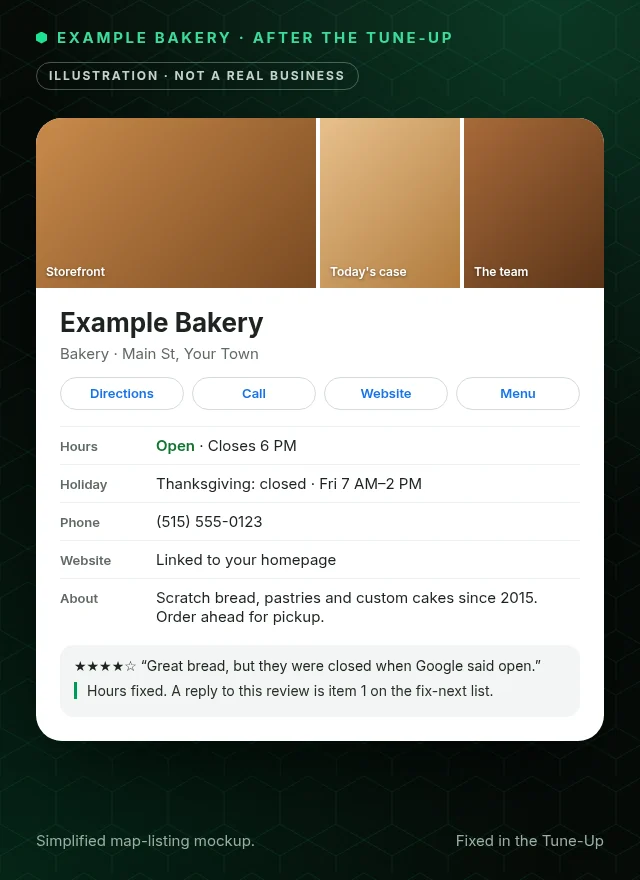
Notice the review in the “before” picture: “closed when Google said open.” That one sentence is the whole case for the Tune-Up. Wrong hours don't just cost one visit; they get written down where every future customer can read them.
What the $79 Tune-Up delivers
Four things, for one business location, one time. No monthly fee, and no password sharing: you add us as a manager with Google's own button and stay the owner.
1. Your Google listing, cleaned up
Hours, holiday hours, photos, categories, description and service area, fixed and filled in so what people see on Google matches the real you. The bakery listing above shows the difference.
2. A printed review QR card
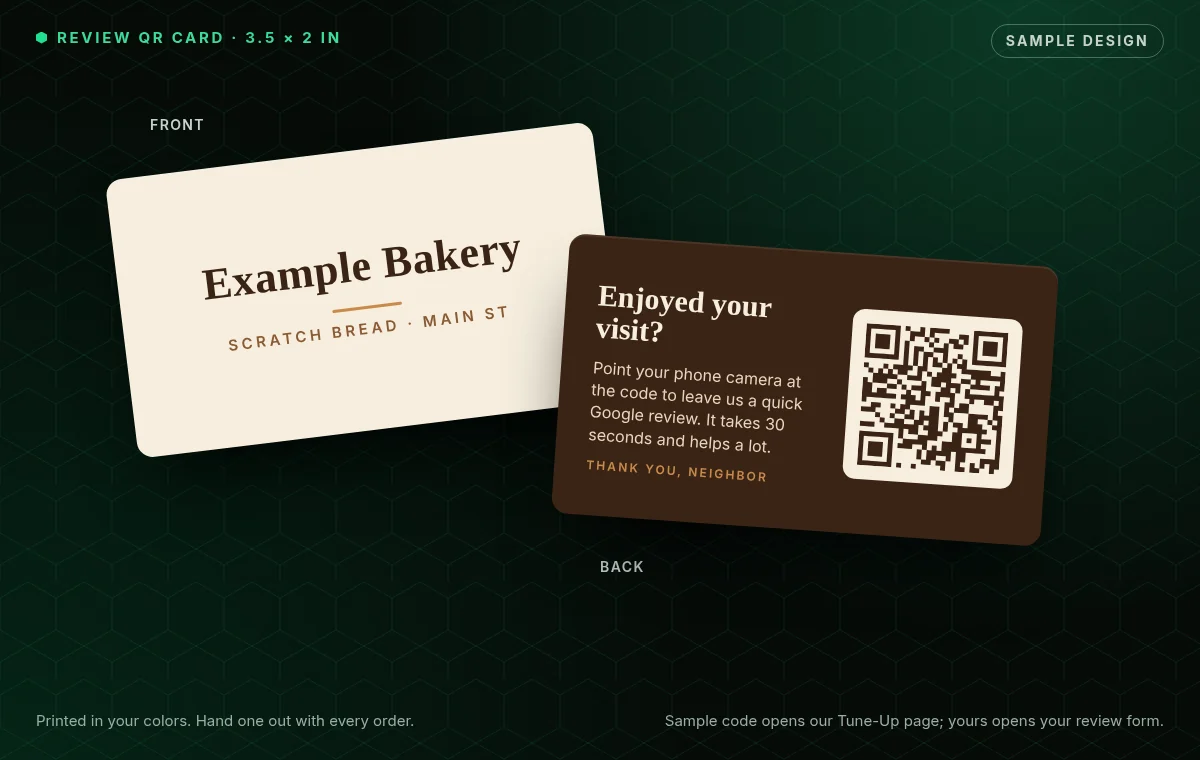
One scan opens your Google review form: no searching, no app. Hand one to every customer, not only the regulars. Google's rules don't allow paying for reviews or only asking the people you expect to be happy, and the card is designed to invite everyone.
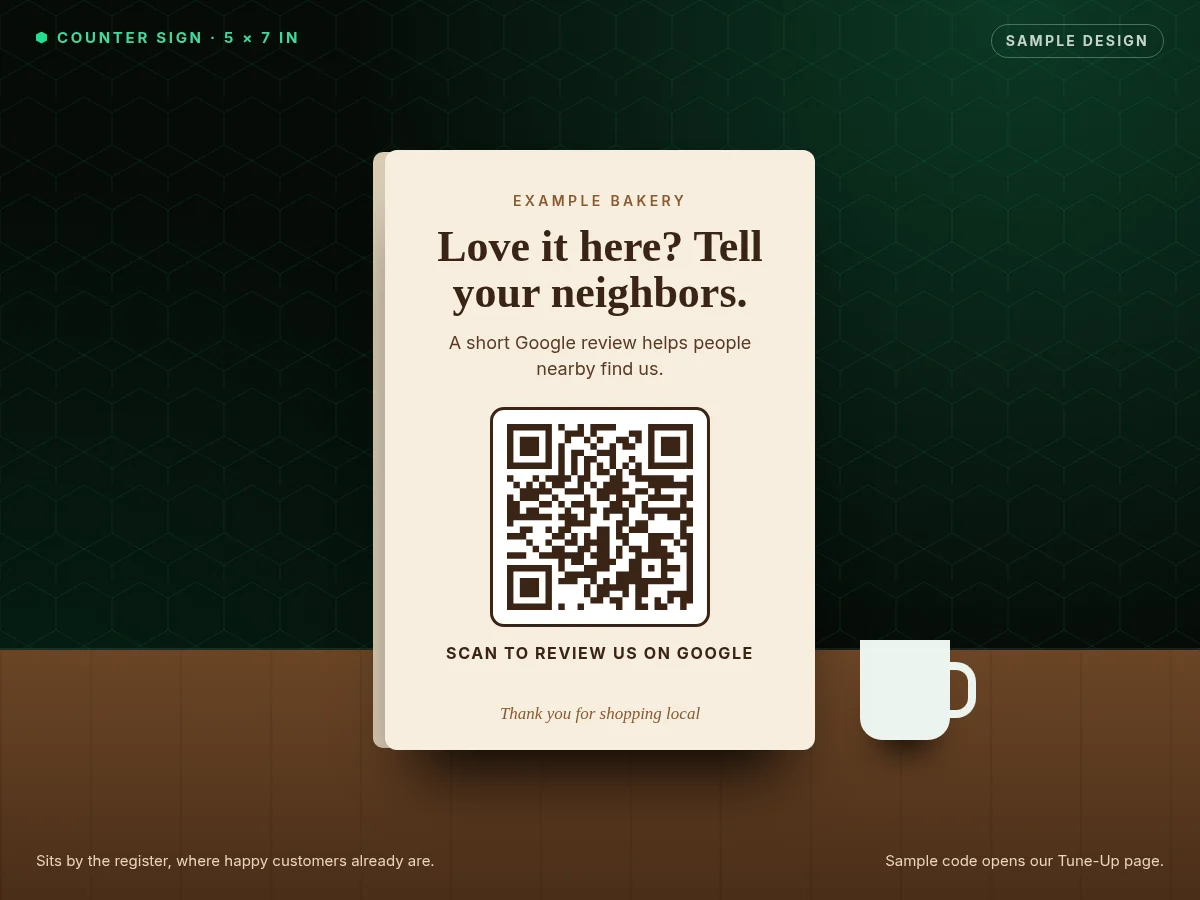
3. A counter sign
4. A one-page fix-next list
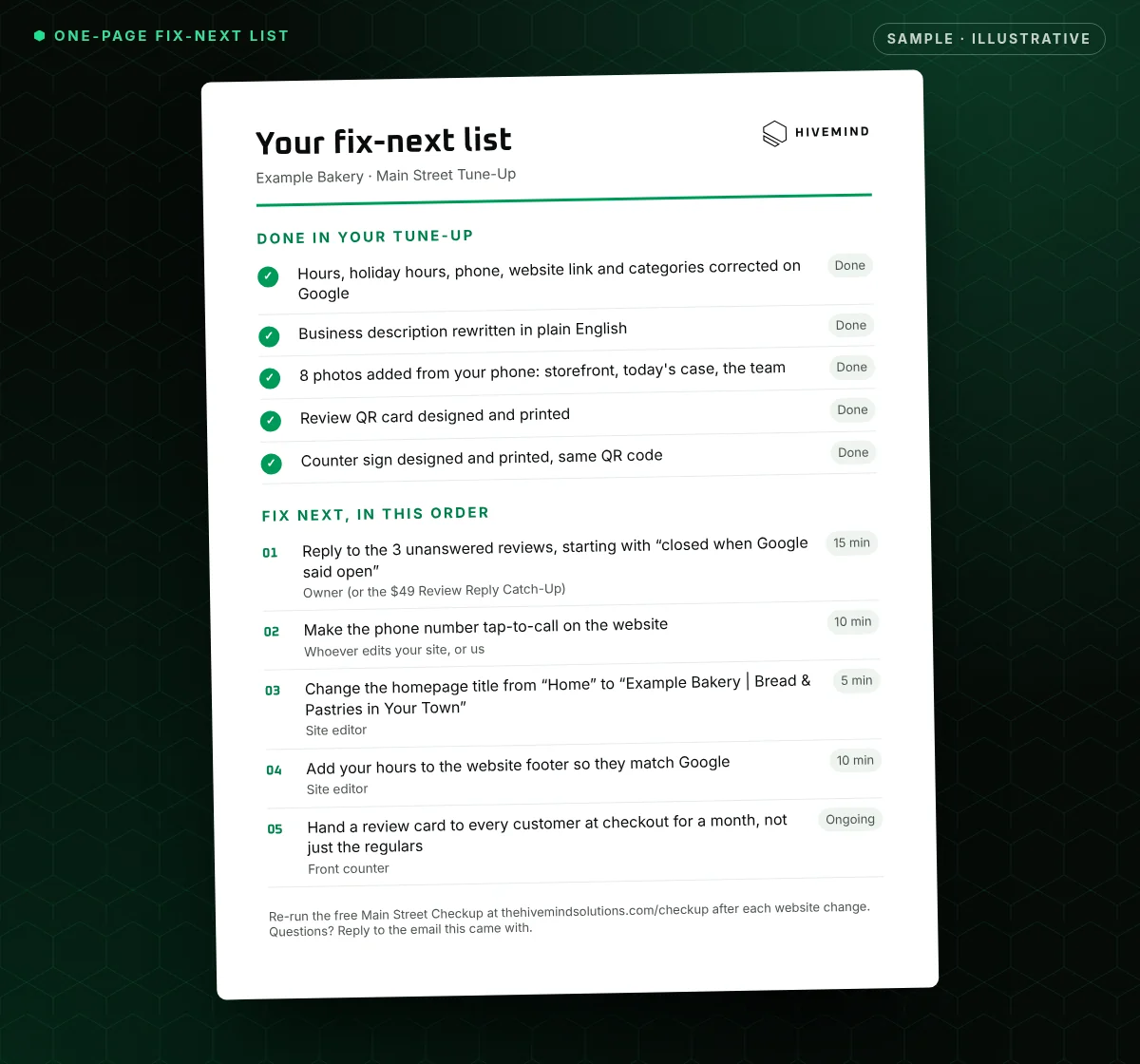
Here's the same sample list as text:
Done in the Tune-Up: hours, holiday hours, phone, website link and categories corrected on Google; description rewritten in plain English; 8 photos added from the owner's phone; review QR card and counter sign designed and printed.
Fix next, in this order:
- Reply to the 3 unanswered reviews, starting with “closed when Google said open.” (Owner, about 15 minutes, or our $49 Review Reply Catch-Up.)
- Make the phone number tap-to-call on the website. (Whoever edits the site, about 10 minutes.)
- Change the homepage title from “Home” to “Example Bakery | Bread & Pastries in Your Town.” (About 5 minutes.)
- Add hours to the website footer so they match Google. (About 10 minutes.)
- Hand a review card to every customer at checkout for a month. (Front counter, ongoing.)
Every item has an owner and a time estimate, and none of them requires hiring us. That's deliberate: the list is yours to keep, with no obligation.
What the checkup can't tell you
Being straight about limits is part of the demonstration:
- It reads one public page, the one you type in, as delivered by your server. Sites that draw everything with JavaScript may look emptier to it than they do in a browser, and it tells you when that's likely.
- It can't see your Google listing. Google doesn't offer a public tool for that, so the checkup includes an 8-question Google listing self-check you answer yourself.
- Speed is measured from our server, not your customer's phone, so treat it as a rough signal.
- A perfect score doesn't guarantee rankings, calls or sales. Nobody can promise that. It means the basics are no longer in the way.
Your turn
Run the checkup on your own site, then take the Google listing self-check on the same page. If you'd rather hand the whole thing off, the Tune-Up is $79, one time.
Run the free checkup → See the $79 Tune-Up Ask Alexander a question